
October 24, 2022
Sóley Tómasdóttir writes:
On October 24, 1975, almost all women in Iceland went on strike for the first time. Factories were paralyzed, telephone answering and fish processing stopped. Housework was barely done.
Nursing and care for the elderly and sick was minimal. Children appeared in workplaces that had rarely or never received such visits. Many men made their debuts changing diapers, boiling potatoes, and incubating eggs.
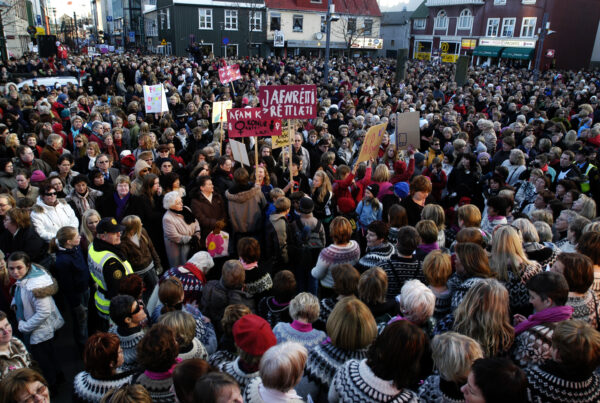
The 1975 women's strike was one of the best products of women's solidarity. That day's outdoor meeting, the largest in Icelandic history, was organized by women who had long had enough of men's contributions to society being seen as more valuable than women's.
Six women's strikes
Since then, six women's strikes have been held, the next in 1985. Then an exhibition was held in a half-timbered building that now houses the Central Bank. The exhibition was called Kvennasmiðja, the woman – the work – the choice, and gave people an insight into women's participation in society. Again, a large number of women rushed to Lækjartorg, where they demanded real equal pay. The law on equal rights for women and men, which had been passed following the meeting 10 years earlier, had not achieved its goal.
In 2005 and 2010, women broke their own record for the size of their outdoor demonstrations twice, when around 50,000 women gathered in the city center with the same demand in mind; real equal pay, which was still far from being achieved. In 2016 and 2018, the slogan was "Equal Pay Now" and the emphasis was placed on the need to change not women, but society.
Four thousand billion
It's been 47 years since the first women quit their jobs. Just over a working lifetime. Let's look at what's happened since then. If we assume a 14% wage gap, an average monthly income of 500,000 ISK in current value, and 90,000 women in the labor market (which is all conservative estimates), then:
– Each of these women made 80,000 ISK per month.
– Each of these women benefits from one million krónur per year, or 46 million in total.
– Society saved over 4000 billion by snorting these 90,000 women.
Normal demand
Instead of meeting the demands of our forefathers in 1975, governments and employers have been busy writing and amending laws, establishing and dismissing committees, and setting up working groups to report over and over and over again. Despite this, employers still get away with taking illegal discounts on women's work. Society only pays for a fraction of women's contributions to raising, cleaning, caring for, and nursing, not to mention the organization and management of all this.
For my sake, there is no need to put much effort into making demands for future collective agreements or negotiating fairness. Laws, regulations, working groups, committees and reports are all on the same page. Society's value system needs to be adjusted and women paid fairly for what they do.