
October 24, 2023
Bryndís Guðmundsdóttir, Helga Björg O. Ragnarsdóttir and María Björk Lárusdóttir write:
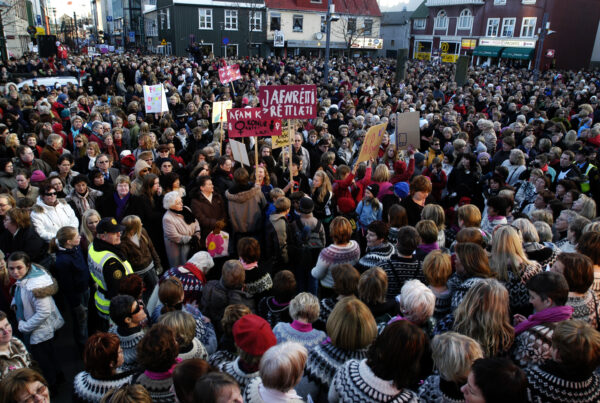
Today marks 48 years since women in this country walked off the job to demonstrate the importance of their work and demand recognition of women's paid and unpaid contributions to society. It is estimated that around 90% of women walked off the job on this first Women's Day on October 24, 1975. The position of women in the labor market was much worse than that of men, and women's jobs were generally ranked at the bottom of the wage scale, among other things because they were not the breadwinners of their families. At that time, women had to (and some still have to) face accusations of neglecting their children and homes due to their participation in the labor market, in parallel with increased employment participation. The 1975 Women's Day shook up Icelandic society and subsequently the first Icelandic equality laws were enacted, which were intended to promote gender equality in all areas of society and stipulated, among other things, that the sexes receive equal pay for equal and equally valuable work.
Iceland, the paradise of equality?
Since then, there has been considerable progress in gender equality. Women's opportunities for employment have increased, along with an increased supply of daycare, preschool and leisure time places. Nowhere in the West is the proportion of women in the labor market higher than in Iceland, and various measures have been taken to combat the gender pay gap. The fight against gender-based violence, prostitution and human trafficking has been strengthened and maternity leave has been extended. The number of women has increased among elected representatives in the Althingi, in local governments as well as in public sector councils and boards and on company boards. Iceland has also, for some time, held the top spot on the World Economic Forum's list of countries with the highest levels of gender equality. When this development is compared with developments in many other countries, it is not surprising that Iceland is referred to as an equality paradise.
There is every reason to celebrate the victories that the women's liberation struggle has achieved, but we cannot ignore the fact that we still have a long way to go in terms of equality in this country. The World Health Organization estimates that about a third of women in the world are victims of violence by men in intimate relationships, and the trauma history of women shows that the proportion is closer to 40% in this country. Equal pay is also not achieved, even though 65 years have passed since Iceland ratified the Equal Pay Convention of the International Labor Organization and thus committed itself to ensuring equal pay for men and women for equal work of equal value.
Gender pay gap
According to Statistics Iceland, the unadjusted gender pay gap was 9.1% in 2022, in favor of men. The pay gap varies by market, but that year the unadjusted gender pay gap was 13.5% in the general labor market and 9.1% among state employees, but considerably lower or 6.1% among local government employees.
But figures on the unadjusted gender pay gap do not tell the whole story, as several methods are used for measurement that yield different results. In addition to annual measurements of the unadjusted gender pay gap, Statistics Iceland conducts wage surveys every few years, and the latest study found that in 2019 the gender pay gap was 25.5%, the unadjusted wage gap was 13.9%, and the adjusted wage gap was 4.3% in favor of men. These different methods of measurement can cause confusion. Here, therefore, an attempt is made to shed light on what these methods of analyzing the pay gap tell us in human terms.
What does this tell us?
Comparing the earnings of men and women shows us how much the gender pay gap differs regardless of working hours or other factors. If working hours are taken into account, we get the so-called unadjusted pay gap . By using even more variables such as education level, job, industry and type of company to explain the pay gap, we arrive at the adjusted pay gap .
It can be said that the difference in employment income and the unadjusted wage gap shed light on the socio-economic reality of the sexes and the consequences of the gendered labor market on the economic position of the sexes. The adjusted wage gap then sheds light on the wage gap once certain factors have been taken into account and controlled for. To illustrate, consider a wage analysis where only the effect of industry is adjusted. In that case, the adjusted wage gap tells us what the gender wage gap is excluding the effect of industry on wages.
Let's take an example of a woman and a man who have the same level of education, have the same amount of work experience, have the same management responsibilities and are both full-time employees. He in the finance department and she in welfare services. His base salary is 690 thousand and hers is 610 thousand, he gets paid fixed overtime for 25 hours per month and she for 10 hours per month. Then he gets 30 thousand per month and she gets 10 thousand per month due to other factors that are not defined in more detail.
His total salary is 880 thousand per month and hers is 681 thousand per month. The difference in basic salary is 70 thousand, which can be attributed to different job valuations, where masculine aspects such as financial responsibility are valued more than, for example, responsibility for the welfare of people. There is also a difference of 109 thousand krónur in overtime pay in his favor, and he receives 20 thousand krónur more than her due to other unspecified factors.
In this example, the difference in employment income is 22%, the unadjusted wage gap is 8% and the adjusted wage gap is 2%. This only aims to reduce the adjusted gap, as job and industry are among the explanatory variables, ignoring the gender division of the labor market and the skewed valuation of jobs where traditionally women's jobs are valued lower than traditionally men's jobs.
The gender pay gap is an economic reality for women
But pay inequality is not just a statistical issue, but a socio-economic reality for women that affects their quality of life and economic status throughout their lives.
For a woman earning 700,000 ISK per month, a 10% wage gap means about 80 thousand ISK per month, 960 thousand ISK per year, and over 47 million ISK over a working lifetime . Not to mention the impact on pension payments and the economic status of women in later life .
With this example in mind, it is clear that wage inequality can have a huge impact on women's status, independence, and financial security throughout their lives.
Gender-segregated labor market and job valuation
The gender pay gap can be largely attributed to a gender-segregated labor market. This means that men and women work in different industries and occupations. Traditionally women's jobs are generally less valued than traditionally men's jobs. For example, jobs in social, health and educational institutions are generally less well paid than jobs in construction and finance. Over time, women have been encouraged to pursue education and work in traditionally male-dominated fields in order to combat the gender pay gap. While this is good in itself, it does not solve the undervaluation that exists in traditionally women's jobs. It is essential that the measures taken to combat wage inequality are targeted and address the root of the problem.
The distorted valuation of jobs needs to be corrected.
To combat the pay gap created by the gender-biased labor market, we need to focus on the valuation of jobs and examine what factors are considered when determining pay. Is responsibility for people's well-being valued equally with financial responsibility? Is emotional stress valued equally with physical stress? Are factors such as harassment from service users and the risk of infection as well as temperature and pollution considered when assessing working conditions? If not, what is the reason?
Salary setting must be based on professional criteria that cover all jobs with the aim of ensuring fair salary setting for all, as required by the equal pay provisions of the law.
Equal pay certification alone does not guarantee equal pay.
Equal pay certification is intended to promote equal pay by implementing a management system that ensures professional and objective wage setting. This involves employers implementing criteria to be used in assessing the value of jobs that must not involve discrimination. The standard does not discuss the requirements for these criteria other than that they must not involve direct or indirect discrimination. If the criteria on which wage setting is based are not designed to value female aspects of jobs equally with male aspects, they will not be useful in combating the wage gap that arises from the gender-segregated labor market and the underestimation of the value of women's work. Unfortunately, it is not inconceivable that in companies that have received equal pay certification, there may be a gender pay gap due to an incorrect valuation of jobs.
The fight for equality under the aura of gender equality
Gyða Margrét Pétursdóttir, professor of gender studies, has discussed the social process or phenomenon where men and women convince themselves that equality exists despite the fact that the reality is different, and calls it the aura of gender equality. It is difficult to work on actions for equality in a society where people allow themselves to believe that it is not needed despite the availability of data and information to the contrary.
It has been observed that employers refer to equal pay certification as confirmation that equal pay has been achieved, thus supporting the illusion of Iceland as an equality paradise. It is important to take declarations of complete victory in equal pay issues with caution and to encourage employers who have the will and ambition to work towards equal pay to ensure that the criteria on which their pay is based actually include that female-dominated jobs are valued equally with male-dominated jobs. In this way, the equal pay standard can be used as a tool in the interest of equal pay.